
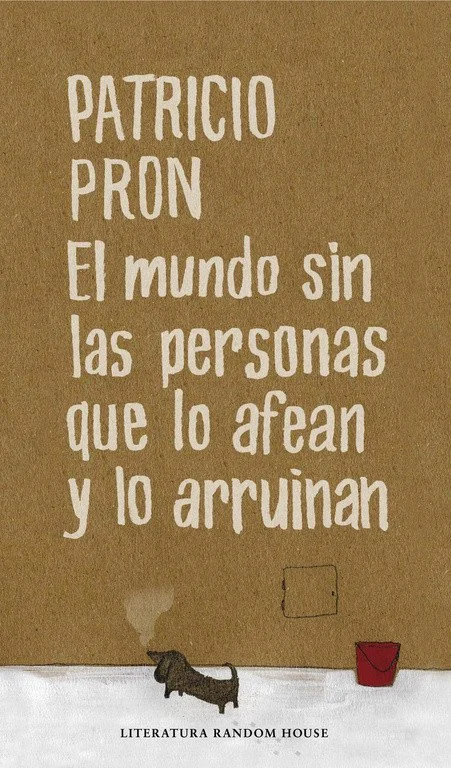
El mundo sin las personas que lo afean y lo arruinan
Patricio Pron
SHORT STORIES | 2010 | 224 pages
“One doesn't end up sticking one’s nose into it due to bad writing; on the contrary, writing is the result of sticking one’s nose into it and having nowhere to go”, Anton Chekhov once said. Elsewhere, describing the origins of THE WORLD WITHOUT THE PEOPLE WHO DISFIGURE AND RUIN IT, Patricio Pron claimed: “Here, in Germany, I stuck my nose into it and had nowhere to go. The snow falling on my back cut out a figure on the ground that was mine, drawn by omission on the tiles, like that of a ghost.”
While the critical praise for his novel THE START OF SPRING brought Pron as an author out of the shadows, THE WORLD WITHOUT THE PEOPLE WHO DISFIGURE AND RUIN IT confirms the quality of his incisive, powerful and precise writing. The eighteen stories that make up the book are a sober way to dispense with all the conventions of the genre, as well as an extraordinary exploration of identity, memory, lies and, above all, writing as a profession, an art and a way of life. THE WORLD WITHOUT THE PEOPLE WHO DISFIGURE AND RUIN IT reminds us that the struggle and determination of writers, and their foolish pride, sometimes also lead to intimate and secret glory.
RIGHTS: spanish LITERATURA RANDOM HOUSE
“Stories with exquisite solitude, the sophisticated coldness in style and penetration of sadness they impose can
be justified by the obsessive presence of photographs, like naked imagines without any possible explanation, in
his stories.”
“Strange, audacious, impeccable, the stories that Pron has included in The World Without the People Who Disfigure and Ruin It [...] never stray far from the formal perfection cultivated by storytellers like Horacio Quiroga and Jorge Luis Borges, nor from the risky writing that characterized the work of Roberto Bolaño and Juan Rulfo [...] these small narrative artifacts are capable of penetrating the folds of everyday life until they produce a sensation that is at once strange and threatening, with a clean, cerebral style, full of powerful images and desolate landscapes which characters, writers and persons who have forever lost their place on the earth pass through.”
“How long have we been hearing talk about the death of the short story, of the impossibility of taking it out of its formal corset, of its nearly inevitable and depressing fate as a workshop exercise? These texts raise, such is their power, the motto repeated by one of its characters: ‘the particular statute of the short story, periodically given up for dead by critics and, however, is still alive in some fashion. [...] a collection of powerful, meticulous and solid texts rarely seen in Argentine storytelling in recent generations.”
“[...] complex and profound characters, unfathomable abysses where even the people we know (father, mother, family) become strangers. [...] a delicate heartbreak which will leave no one indifferent.”
BY PATRICIO PRON:
En todo hay una grieta y por ella entra la luz
FICTION, 2026
El espíritu de mis padres sigue subiendo en la lluvia
FICTION, 2011/2024
La naturaleza secreta de las cosas de este mundo
FICTION, 2023
No, no pienses en un conejo blanco: Literatura, dinero, tiempo, influencia, falsificación, crítica, futuro
ESSAY, 2022
Mañana tendremos otros nombres
FICTION, 2019
Trayéndolo todo de regreso a casa
SHORT STORIES, 2019
Lo que está y no se usa nos fulminará
SHORT STORIES, 2018
Caminando bajo el mar, colgando del amplio cielo
CHILDREN’S, 2017
No derrames tus lágrimas por nadie que viva en estas calles
FICTION, 2016
Nosotros caminamos en sueños
FICTION, 2014
El libro tachado
ESSAY, 2014
La vida interior de las plantas de interior
SHORT STORIES, 2013
El mundo sin las personas que lo afean y lo arruinan
SHORT STORIES, 2010
El comienzo de la primavera
FICTION, 2008