
Dónde puedo dejrlo
Alejandra Costamagna
NOVEL | 2026 | 284 pages
A hypnotic novel about friendship, disappearance, and memory that sheds light on the most fragile years of Chile’s history.
“If you don’t come, I’ll die.” That is Mara’s friendly threat to Manu, or at least that’s what it seems like based on the six words written in one of their notebooks that the other will have to try to use as clues years later. It’s December 1989, the last summer of an era for two women who have just turned eighteen. One—the girl who invites the other to join her—needs an escape. The other one stays behind, but she doesn’t know that this is goodbye and that from that point on, she will be facing a void, that memories will bang against each other in her head and cause chaos, that time will shatter, and that her existence in this new reality will be shaped by the projection of a life she once took for granted.
What do we do with things that are gone? How do we come to terms with that empty space? What role does imagination play in the stories we tell each other? How many people are we, or how many can we turn into if we work on transforming into others?
In this brief but powerful and enigmatic novel, reality gradually transforms into a chaotic space that upends the narrative. The story of a friendship cut short is also an exploration of when words fail to convey what they mean, of the characters we play and our search for slippery identities, about loss and grief, about the illusion of time as an arrow in constant motion, and about the vagueness of memory in contrast to the precision of affection.
Dónde puedo dejarlo places itself on the thin line between memory, fantasy, and reverie.
RIGHTS: spanish ANAGRAMA
“Through a hauntingly reflective narrative, Dónde puedo dejarlo demonstrates the extent to which the heart of History beats not at the center of the explosion but rather in its most unexpected shards. An extraordinary apologia for friendship as conspiracy.”
“The novel begins as the account of a disappearance set within a historical context — Chile in the early nineties, still scarred by violence — but it drifts toward another territory: an inquiry into what persists of someone when they are no longer there. Mara ceases to be merely a character and becomes a form of thought, a presence difficult to pin down. An image persisted as I read: leaving a place at the table for whoever is missing. That is how the novel is to be understood: not as an attempt to resolve the disappearance, but to sustain it. The coda — as the author calls the final section — is not a closure: it seems to continue beyond itself. Mara is not contained within its pages; she drifts. And with her, the need to search for her. Not so much with the expectation of finding her as with the impossibility of ceasing to do so. As if, somewhere — in Rome, in Madrid, in New York, in another life — she might still appear. And it is in that tension, without possible resolution, that the novel reaches its most enduring form.”
“A beautiful and moving novel, centred on mystery, pain and strangeness, which explores the question of identity, written in a careful, sensitive style, rich in resonance and subtlety.”
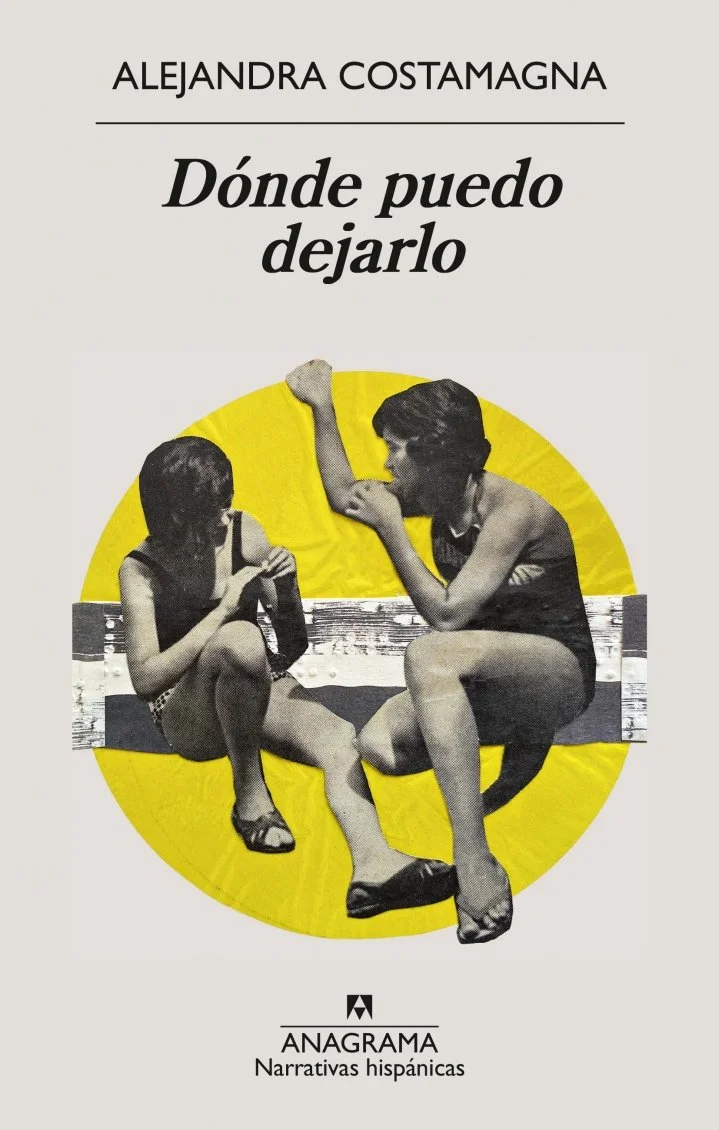
Dónde puedo dejarlo
NOVEL, 2026
Dile que no estoy
NOVEL, 2007/2021
El sistema del tacto
NOVEL, 2018
Imposible salir de la Tierra
STORIES, 2016
Había una vez un pájaro
STORIES, 2013
Cruce de peatones
JOURNALISM, 2012
Animales domésticos
STORIES, 2011
Naturalezas muertas
NOVELLA, 2010
Últimos fuegos
STORIES, 2005
Cansada ya del sol
NOVEL, 2002
Malas noches
STORIES, 2000
Ciudadano en retiro
NOVEL, 1998
En voz baja
NOVEL, 1996