
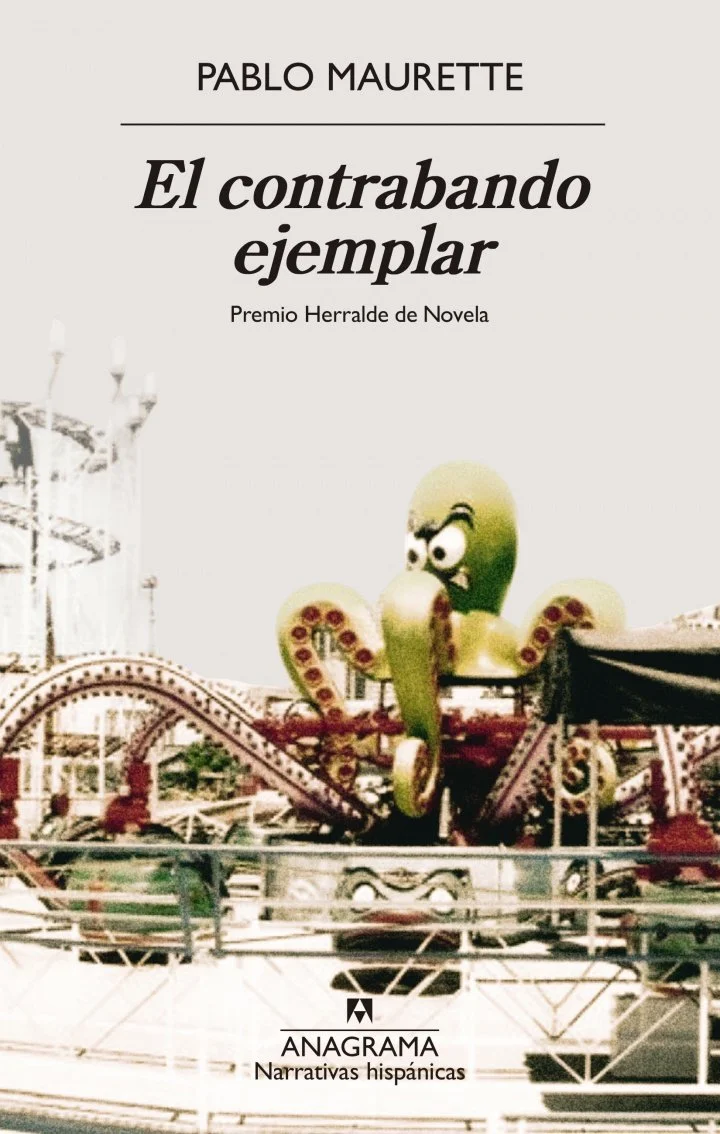
El contrabando ejemplar
Pablo Maurette
NOVEL | 2025 | 344 pages
WINNER OF THE 2025 HERRALDE NOVEL PRIZE
A celebration of the personal and the collective that turns the act of storytelling into a unique and moving literary experience. A novel that finds its place within the tradition of the best Latin American writing.
Pablo, an aspiring writer without many hesitations, travels to Madrid to recover the manuscript his friend and mentor Eduardo left behind when he died. It's a book Eduardo never finished that attempted to explain the unexplainable: the unfortunate fate of Argentina, which shaped its economy during the 17th century with a clandestine trade system known as "exemplary contraband."
Determined to take over Eduardo's impossible novel (a literary undertaking that is simultaneously a tribute and an atonement, a looting and an elegy), Pablo will face a process that will lead him to reconstruct his own biography as well as Eduardo's: a Peronist who was over the top and sentimental, a boundless figure characterized by contradictions and melancholy. Among its pages are characters that are pulsing with intensity: Aunt Chiquita and the enigmatic Teruca; Pietro Malaspina, the first Italian who set foot in Río de la Plata; Zebulão Mendes, a Jewish convert doctor; and the Querandí monster, a grotesque folkloric figure whose curse seems to loom over Argentina.
Neurotic, tender, violent, and humorous, they all come together in a mosaic where history, imagination, and the sentimental chronicling of Argentine identity merge together. Neither a nostalgic ode to memory nor a historical reconstruction, El contrabando ejemplar is a novel that questions the meaning of what is lost and what is invented.
RIGHTS: spanish ANAGRAMA
“A family saga, an impossible detective story, and the outline of a country’s history and its old and incurable affliction. With these elements and several unforgettable characters, El contrabando ejemplar provides an answer to the question of what it means to belong to a particular place, a culture, and a past with powerful imagination and sharp humor. And perhaps the best novel about any subject is the one that is written while seemingly seeking something else.”
“The proverbial Argentine verbosity is on full display, brought to life by a gallery of eccentric characters who weave together a delirious and provocative interpretation of the country’s history. An overwhelmingly funny novel.”
“Both centrifugal and completely centripetal, El contrabando ejemplar is a delightful journey through our historical and personal fictions, through the anomalous, monstrous, and hybrid nature of people, cultures, literatures, and countries. In this never-ending tale, a story is pure hope, an essential condition for human existence, joy, invention, and life itself.”
“‘Where did Argentina go wrong?’ What history cannot answer, literature investigates, twists, invents, and speculates upon. In El contrabando ejemplar, this question—ambitious, mischievous, and controversial—serves as both the narrative’s driving force and blind spot. With intelligence and courage, Maurette draws on and subverts literary tradition. The intimate merges with the historical and social, and desire advances in the form of storytelling because, as long as there is a story, the world can still be ordered. ‘For someone like me with no children, all my desire is put into literature,’ says Pablo, Pablito, the narrator. That desire has brought an exemplary form of contraband into Argentine literature: this incredibly insightful novel.”
“The only ‘flaw’ I found in El contrabando ejemplar is that it isn’t 300 to 500 pages longer. I admire its focus and compression and understanding. It’s one of those books you are happy to have read but that you’re sad to not keep reading.”
“Maurette uses both clandestine trafficking and teratology not only as recurring motifs in his exploration of Argentine identity, but also as constructive principles of the work itself, and this coherence between subject matter and technique—along with a highly crafted prose, interwoven with diverse tones and accents—makes the novel the most fitting (and literary) Herralde Prize winner in recent years. (...) Maurette offers us a historical novel (or rather a historiographical metafiction), a reflection on the value that the past can have when interpreting the present [...], and a self-generating novel (one that narrates its own genesis) on the meaning of writing fiction today. In short, a prize-winning novel with every merit.”
“With imagination, humor, and a wealth of cultural and literary references, the novel—winner of the 2025 Herralde Prize—is populated by numerous characters and tells the story of two friends, one a fervent Peronist and the other an anti-Peronist. It questions the truth of myths and collective fictions and seeks to approach the Argentine soul and identity.”
“[In this novel] the personal merges with the historical and social, while literature as a cultural artifact investigates and invents that which history cannot fully explain.”
“I consider it a wise decision to have recognized Pablo Maurette’s El contrabando ejemplar’ with the Herralde Prize (...) [The novel] bursts forth like a protean mosaic where history, myth, and literature intertwine. (...) Unique and creative, it breaks the mold, even excessively, with the many twists and turns it pursues. In contrast to the inveterate solipsism that has become so common in recent literary prizes, this almost deformed mosaic is arrives to readers like a breath of fresh air, precisely because it connects with the novel’s unrestrained writing style.”
“A novel within a novel—meta-literature that falls within the best literary tradition of Roberto Bolaño and company.”
“El contrabando ejemplar is certainly a novel: a true novel, and not merely a narrative that is more or less lengthy. Because the true novel—the one Borges attacks with valid but refutable arguments in the prologue to The Invention of Morel, accusing it of being capricious and formless; that is to say, monstrous (remember this word)—is not only a narrative of a certain length but a narrative that, in its quantifiable length, postulates an even greater one that flirts with the infinite: all time, all space, all lives, all things. And Maurette achieves this effect of dizzying accumulation, real or virtual, one that was already present in his previous novels.”
“Pablo Maurette calls upon the saints of Borges and Bolaño in order to offer us a rich literary universe that is brimming with stories that border on autobiography and pose more questions than answers along the way. A book that overflows across all eras and places and also serves to highlight the status of Buenos Aires as a global city.”
“In reality, the novel is a puzzle of stories and inventions that Maurette embeds within the main plot, driven by an intrinsic taste for recounting adventures and striking events. This carousel of surprising stories and the fervent exercise of narrative are the pleasant wrapping that houses an incisive reflection—polyphonic, ironic, and skeptical—on the identity of Argentina.”
“Like the vastness of the Argentine pampas, El contrabando ejemplar traverses an enormous and discontinuous space and a non-linear narrative time that becomes a grand imaginative speculation both on Argentina’s past and legendary origins, and on a bleak and turbulent present, all seasoned with an irony that is perhaps the touchstone of the entire book, because it suggests that ‘this Argentina that has to sink. It has to sink and disappear’ is the closest thing to a detective novel.”
“A surprising and well-written novel that combines history, picaresque fiction, essay, biography, reality, and fiction.”
“El contrabando ejemplar is a grand affair…From the combination of personal and collective memory, of present and past, of humor and tragedy, only a somewhat monstrous creature can emerge. A being that, when faced with the adaptation of Vargas Llosa’s well-known question (‘Che, when did Argentina go to hell?’), upon opening its jaws, emits a most beautiful melody, a mixture between a howl and a song, impossible to silence with any chainsaw.”
“Anyone seeking the keys to understanding the political and economic development of Argentina will not find them in this excellent novel, which actually mocks the fatalism that has marked the country’s history. What they will find is the unsurpassed sense of humor that Borges, Cortázar, and Sabato transformed into a national hallmark.”
BY PABLO MAURETTE:
El contrabando ejemplar
NOVEL, 2025
La niña de oro
NOVEL, 2024
Atlas ilustrado del cuerpo humano
ESSAY, 2023
Por qué nos creemos los cuentos
ESSAY, 2021
La migración
NOVEL, 2020
La carne viva
ESSAY, 2018
El sentido olvidado
ESSAY, 2017